
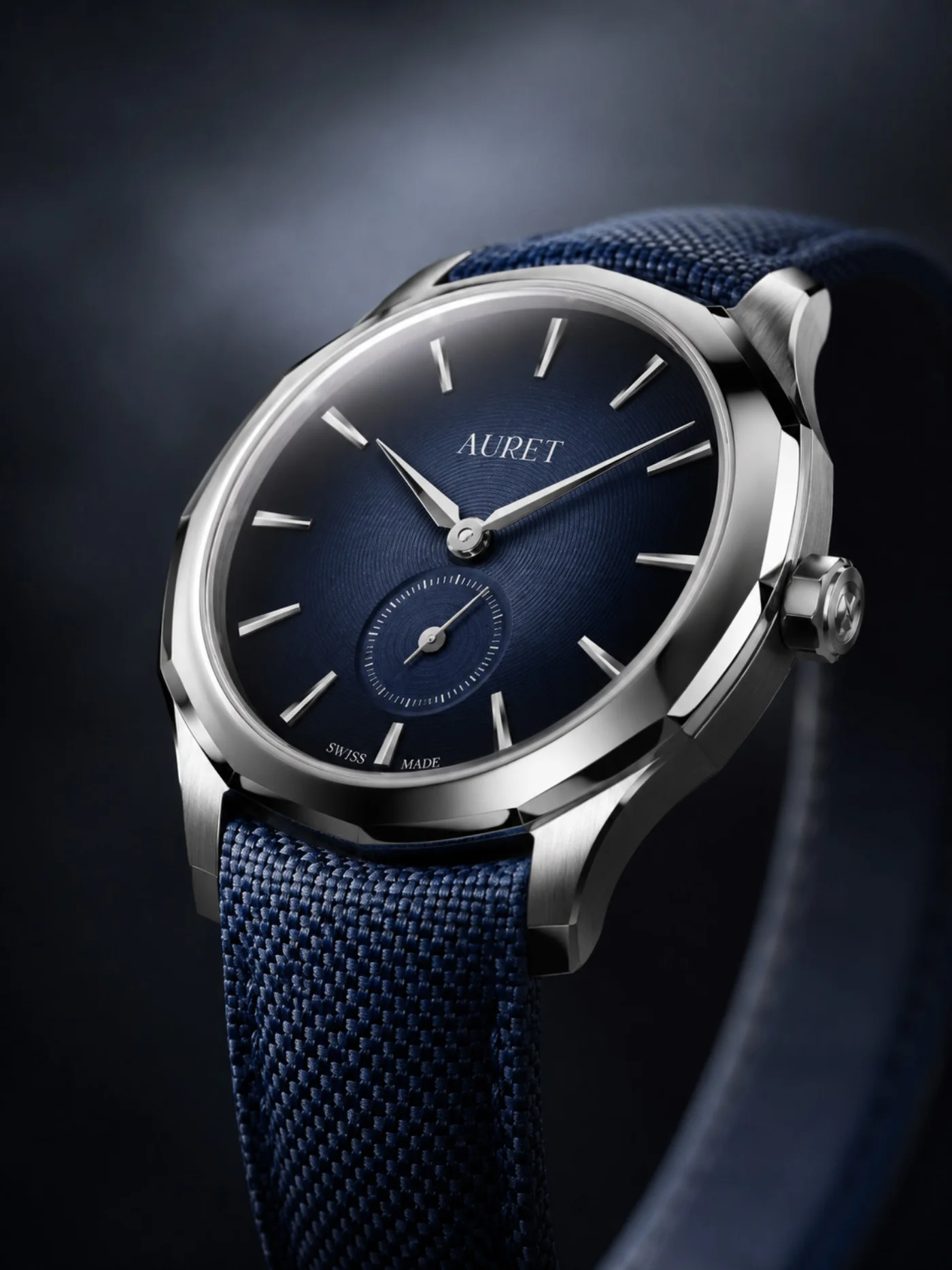
Mederi's guilloché didn't start as a drawing. It started as a question: what does a second look like? Not the second the small hand marks at the bottom of the dial, but the second as a unit of presence — that instant which, in our founder's words, is the only time we truly inhabit.
We found the answer at the centre of the dial. That's where the first wave is born, cut in concentric guilloché with a fumé gradient that darkens toward the edge. The next ones expand from that point, one after another, until they fill the whole face. Every concentric layer evokes an accumulation of experience; the light, most intense right at the centre, speaks of clarity and renewal. It isn't a decorative pattern chosen for its beauty — although it is beautiful. It's a map of how we understand time: not as a line moving forward, but as something that expands outward from now.
Every Mederi colourway carries its own guilloché, but the construction is the same across all three: Origin, Horizon and Permanence share the same centre, the same first second. What changes is where it expands toward — Origin's black toward what hasn't been written yet, Horizon's blue toward a distance tinted with sky, Permanence's burgundy toward what settles and lasts.
Cutting it takes hours of bench work, with the same patience given to every detail inside an automatic Sellita SW260 D4. We don't rush that process. A watch that wants to speak about time can't be made in a hurry.
Each wave represents a second born at the centre, projected outward and transformed toward the future.